The Biggest Lie in Retail Trading
Most traders enter the forex market believing a story that sounds perfectly reasonable. You open an account, deposit some money, click buy or sell, and your order travels into the vast interbank market where banks trade trillions of dollars in currencies every single day. Your trade mingles with orders from the biggest names in finance. The spread you pay covers your broker's costs, and the whole system works like a beautiful, efficient machine.
It is a clean narrative. It is also almost entirely false.
Here is what actually happens. I know this because I have worked on the infrastructure side of brokerage operations — building the systems that process your trades, monitor risk exposure, and route orders. When you buy one hundred thousand euros against the dollar at a typical retail broker, your order does not leave the building. It does not get sent to a bank. In the vast majority of cases, your broker's trading server simply books the opposite side of your trade internally. You bought, so the system sold to you. Your profit and loss is now directly inverse to your broker's profit and loss.
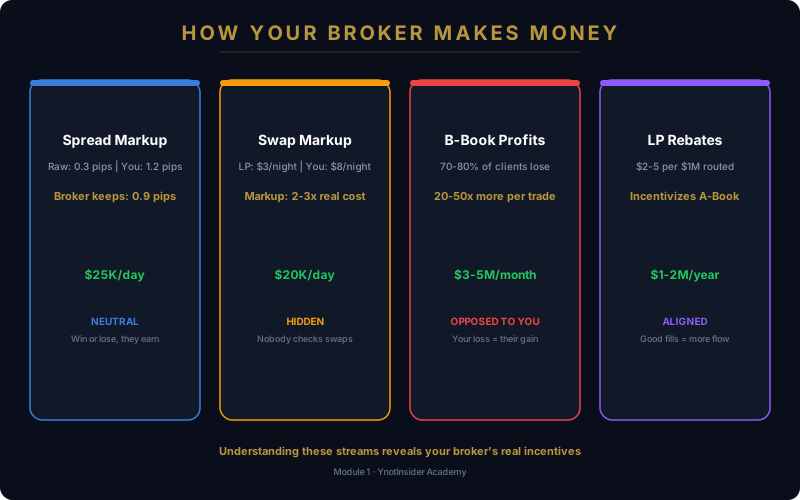
This is not a conspiracy. It is a standard business model called market making, and it is completely legal in every jurisdiction. But it creates a dynamic that most traders never fully grasp, and that misunderstanding costs them real money.
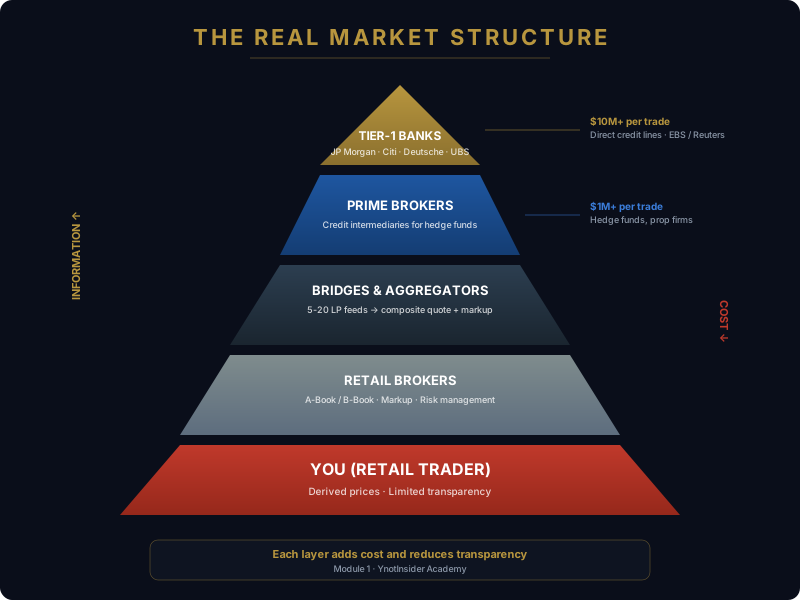
The interbank market does exist. It is where tier-one banks — the top ten institutions that handle roughly sixty percent of all global forex volume — trade with each other through direct credit relationships. They use platforms like EBS and Reuters Matching, and they trade in blocks of ten million dollars minimum. You do not have access to this market. The capital requirements, credit relationships, and infrastructure costs put it permanently out of reach for any individual trader.
What you have access to is a derivative of that market. Your broker connects to several liquidity providers — some are banks, some are non-bank market makers, some are other brokers. A piece of software called a bridge or aggregator collects price quotes from all of these sources, selects the best available bid and ask, adds the broker's markup, and sends that composite price to your trading platform. This happens hundreds of times per second.
By the time a price reaches your MetaTrader or cTrader screen, it has been through at least two layers of transformation. The raw interbank price was adjusted by the liquidity provider based on their own risk, then adjusted again by your broker based on their risk and profit targets. Each layer extracted value. The number you see is real in the sense that you can trade at it, but it is not the same number that Goldman Sachs sees when they trade with Citibank.
Think of it like buying concert tickets through a reseller. The event is real, the tickets are real, but the price you pay includes multiple markups from intermediaries you never see. Understanding this chain does not mean the market is rigged or that you cannot profit. It means you need to account for the real cost structure in your trading strategy.
Here is the part that should genuinely change how you think about trading. On the broker's side, there is a monitoring system that runs around the clock. Every fifteen minutes, automated alerts check the broker's aggregate exposure — their total risk across all client positions. Risk managers watch dashboards showing real-time profit and loss, position concentrations by instrument, and alerts when exposure exceeds predefined thresholds. There are shift reports generated multiple times per day. The broker knows, at every moment, exactly how much money they stand to gain or lose based on how the market moves.
You, the trader, see your own position. They see everyone's positions simultaneously. This information asymmetry is the single most important thing to understand about retail trading. It does not make winning impossible, but it means you need to be strategic about when, how, and where you trade.
This course is going to give you that strategic framework. Over eight modules, we will examine every layer of this architecture — from how prices are formed to how institutional players move billions without leaving obvious footprints. By the end, you will see the market the way a broker's risk desk sees it. And that perspective is worth more than any indicator or trading signal you have ever received.